
Article
How Much Weight Can You Really Lose in 5 Days?
By Dr. Rajat Thapa • March 22, 2026
If you've ever tried to lose weight, you've probably had this experience: you work hard all week, eat carefully, maybe even skip meals, and then step on the scale and it barely moves. Or, just as confusing, it drops quickly for a day or two and then seems to stall.
Both experiences are common, and both can be misleading. The question we need to ask is: if I do everything right, how much weight loss should I actually expect?
The physiological ceiling
The answer begins with a bit of physiology. Your body loses fat when it is in a calorie deficit, when it burns more energy than it takes in. Food quality and its effect on insulin secretion matter, but total caloric deficit still sets the ceiling on how much body fat can be lost.
For many people, a reasonable estimate of daily energy expenditure is around 2,000 calories. Since about 3,500 calories corresponds to one pound of fat, the math sets a firm upper boundary: even under very aggressive conditions, the most fat you can lose in one day is about 0.5 pounds (Hall, 2008).
This is worth pausing on. No matter what a headline or advertisement might suggest, the human body does not shed 10 pounds of fat in a week. Biology simply does not allow it.
What different strategies can actually do in 5 days
Here is what different daily calorie targets can realistically achieve over five days, assuming roughly 2,000 kcal/day of energy expenditure:
| Daily Intake for 5 days | Daily Deficit | Deficit | Fat Loss |
|---|---|---|---|
| 0 kcal (water-only fast) | 2,000 kcal | 10,000 kcal | ~2.8 lb |
| 250 kcal (Buchinger clinic) | 1,750 kcal | 8,750 kcal | ~2.5 lb |
| 500 kcal (5:2 fast style) | 1,500 kcal | 7,500 kcal | ~2.1 lb |
| 800 kcal (Fasting mimicking) | 1,200 kcal | 6,000 kcal | ~1.7 lb |
| 1,500 kcal (Eat less approach) | 500 kcal | 2,500 kcal | ~0.7 lb |
These numbers represent the upper limit of fat loss. Any additional drop on the scale beyond this is mostly water, glycogen, or gut-content changes, especially in the first few days.
Why the scale often falls faster than fat is lost
Many people do see the scale drop by far more than that in the first few days of dieting or fasting. That early, dramatic change is real, but it is not mostly fat. It reflects something else: the loss of glycogen, the water that is bound to it, and the simple fact that there is less food moving through the digestive system (Heymsfield et al., 2011).
Glycogen carries water with it, so when carbohydrate intake falls, the body sheds both. The result can be a rapid drop of three, five, or even seven pounds in a matter of days.
This is where confusion begins. The scale moves quickly, but the underlying fat loss is much smaller.
In my own repeated fasting attempts, I saw this pattern clearly. Over five days, the scale would often fall by five to seven pounds. But when you compare that with the physiological limit of fat loss, it becomes obvious that only about two to three pounds could have been fat. The rest was water, glycogen, and gut contents shifting in response to diet.
What happens after the initial water shift
A more revealing way to look at the data is to remove that initial drop and focus on what happens after the first day. If we take multiple attempts and normalize them so that Day 2 starts at zero, we can see how much additional weight is lost from that point onward. That pattern is shown in Figure 1.
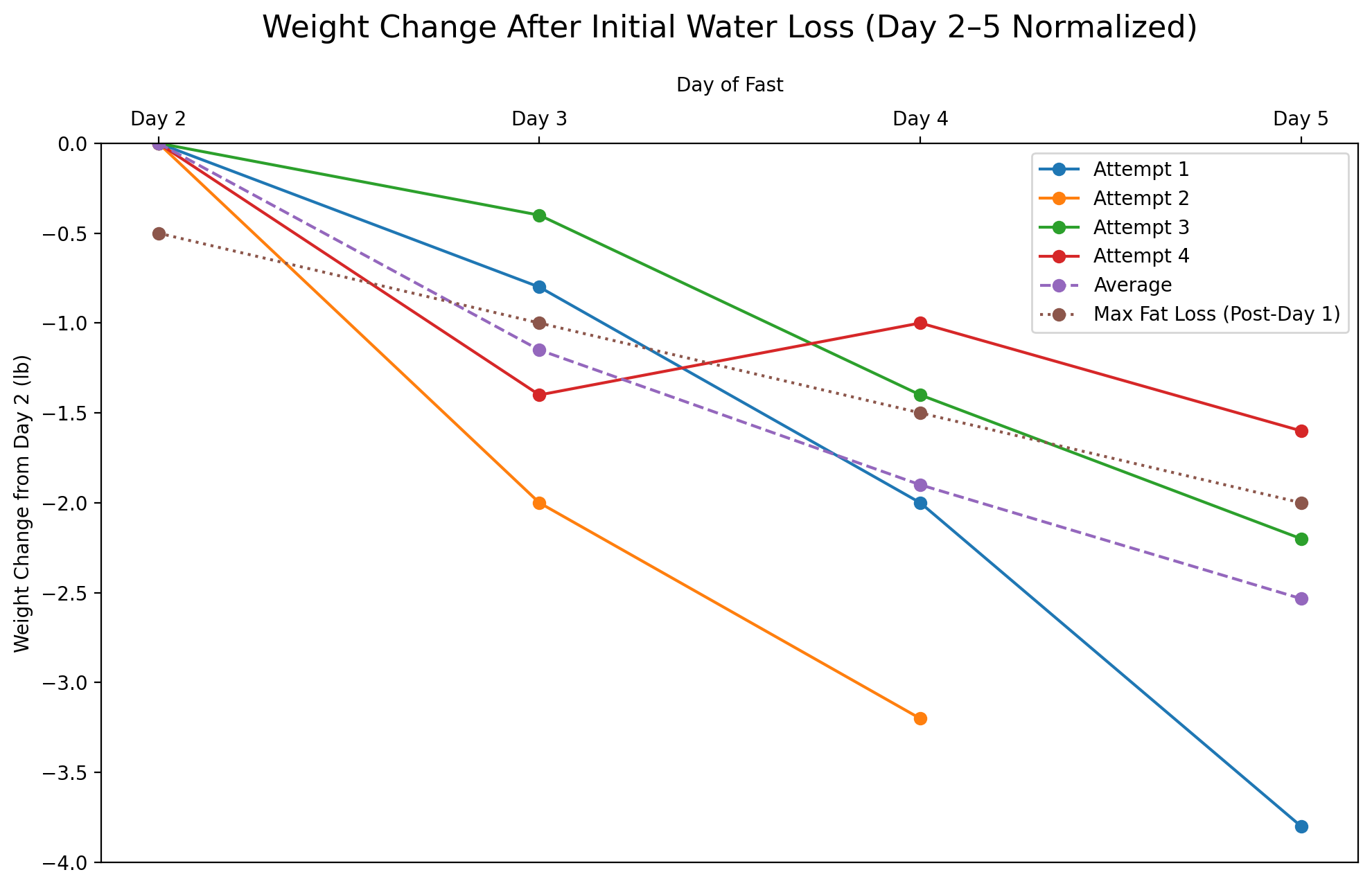
Figure 1. Personal weight-loss data across repeated 5-day fasting attempts on roughly 250 kcal/day, normalized to Day 2 after the initial water-weight drop.
After removing the initial water-weight drop, the average additional weight loss from Day 2 to Day 5 is approximately 2 to 2.5 pounds, with modest variability between attempts.
What emerges is a much steadier, more modest pattern. From Day 2 to Day 5, the average additional weight loss is about 2 to 2.5 pounds. The curves are smoother, the variability is smaller, and the rate of change is far closer to what we would expect from true fat loss (Johnstone, 2015).
Why this matters psychologically
This distinction matters. It explains why the early days of a diet feel dramatic and motivating, while later days, especially by week 2, can feel slow and discouraging.
It also explains why the scale can seem unreliable. Body weight can fluctuate by one to three pounds in a single day based on carbohydrate intake, salt, hydration, bowel movements, and even the time of day you weigh yourself (Sumithran & Proietto, 2013). Eat a higher-carbohydrate meal, and the body replenishes glycogen along with the water that comes with it, and the scale can jump up overnight. That does not mean fat was gained. It simply means water returned.
For someone trying to lose weight, this creates a psychological trap. You can be doing everything right, creating a consistent calorie deficit and steadily losing fat, and still see little or no change on the scale from one day to the next. Or you may see a large early drop and expect that pace to continue, only to feel like you've stalled when it inevitably slows.
The practical takeaway
A more realistic expectation is this: over five focused days, even with significant effort, true fat loss will usually be in the range of two to three pounds at most. With more moderate, sustainable approaches, one to two pounds per week is already excellent progress. Over a month, that adds up to six to eight pounds of real fat loss, which is clinically meaningful and durable (Hall & Kahan, 2018).
The most useful question, then, is not "What did the scale say today?" but rather, "Did I create a consistent calorie deficit this week?" If the answer is yes, then fat loss is occurring, even if the scale is temporarily obscured by water shifts.
If you feel like someone who cannot lose weight no matter how little you eat and how much you exercise, compare your expected weight loss with the caloric deficit you were actually able to maintain. The corrected expectation based on what is physiologically possible is empowering. You do not have to feel that weight loss is out of your control.
Early weight loss can be dramatic because of fluid changes. True fat loss is quieter, slower, and more consistent. But it is also the change that matters. If you understand that, the scale becomes less of a source of frustration and more of a health guide, and you can stay focused on what actually drives progress.
References
- What is the required energy deficit per unit weight loss? (Hall KD. International Journal of Obesity (2008))
- Maintenance of lost weight and long-term management of obesity (Hall KD, Kahan S. Medical Clinics of North America (2018))
- Early phase body composition changes (Heymsfield SB, et al. Obesity Reviews (2011))
- Fasting for weight loss (Johnstone AM. International Journal of Obesity (2015))
- Body weight regulation (Sumithran P, Proietto J. Clinical Science (2013))